
In a quiet inlet of Southladie Voe, West Sandwick, Yell (Shetland), lies the remains of an old wooden wreck. Enough survives to identify her as a probable Class 1 sailing drifter, though her design differs from the more familiar Zulus and Fifies of the Scottish herring fleet. Thanks to local knowledge, we’ve now pieced together her story.
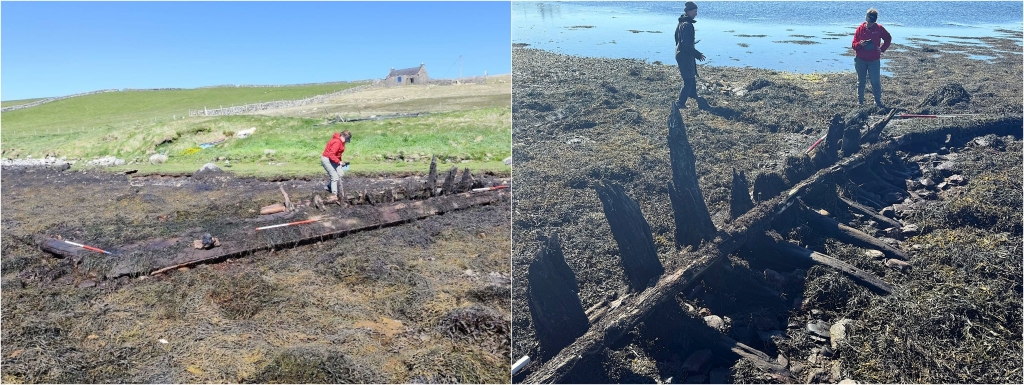
The stern end of a large wooden boat lying on her port side. In the image on the left, you can see her stern post and a possible hawsehole for the anchor chain in the bottom planking. In the image on the right, you can see the tops of her floor timbers surrounded by ballast and the first frame timbers.
An appeal for information back in May 2025 yielded a vital clue from James Goodlad – her name, ‘Candace’. With help from Angus Johnson at Shetland Archives, we traced her through the Register of Fishing Boats, which since 1868 has recorded details of all commercial fishing vessels. The registers contain information about boats and their owners, including previous registrations making it possible to reconstruct the biographies of individual vessels.
Candace was built in 1888 at Page and Chambers boatyard in Oulton Broad, near Lowestoft, and registered as LT171 to T. Aldred. She arrived in Shetland in 1902, re-registered as LK554 to Lerwick fisherman William Gear, then aged 40 and living at Gansons’ Buildings, Market Square. Born in Gletness, Nesting in 1862, Gear was a fisherman-crofter. The register describes Candace as a Class 1 decked sailing drifter with a 50-foot keel, weighing 31 tons, smack-rigged and equipped with lines and nets. She was crewed by six men and a boy.
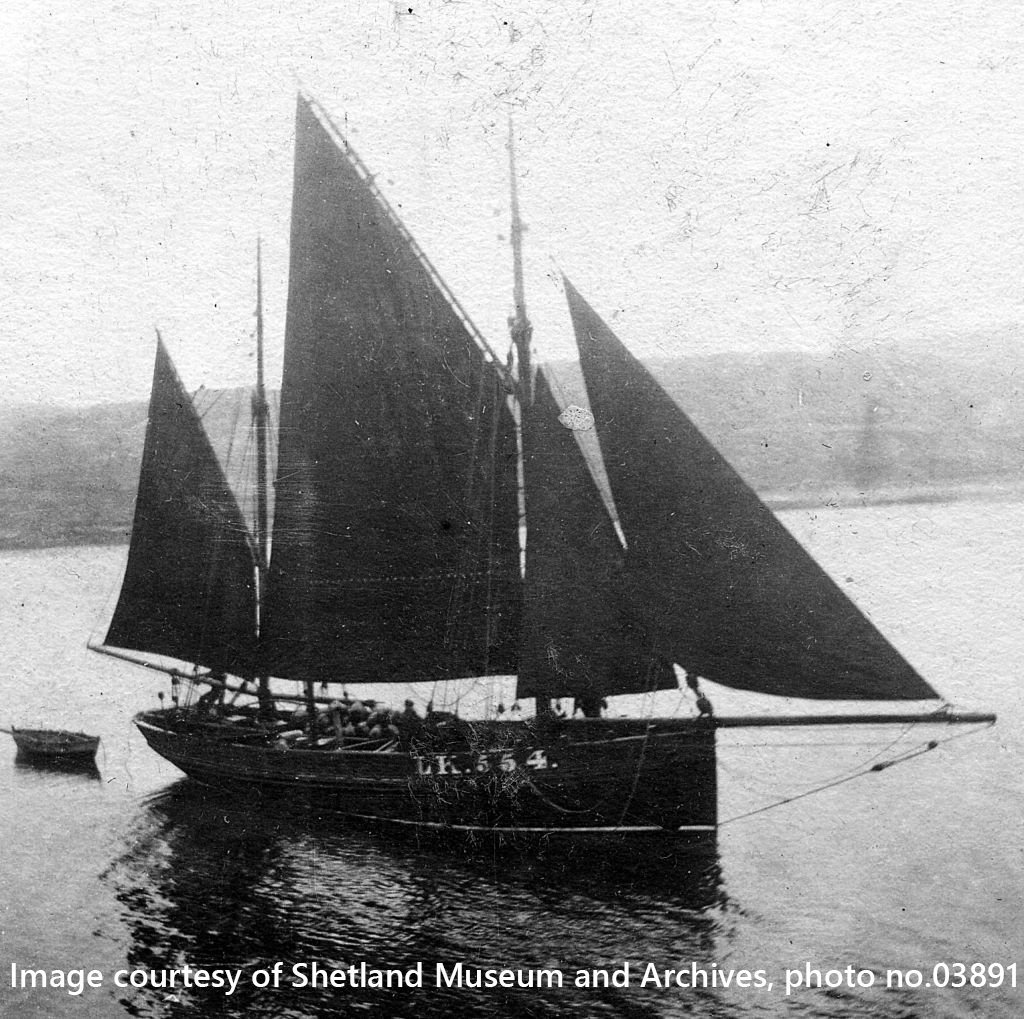
Candace under sail in Shetland
In February 1919, Candace was sold to the Admiralty. Just two months later, she was advertised for sale in the Shetland Times:“OFFERS ARE INVITED for the Fishing Boat ‘CANDACE,’ LK.554, as she lies at Lerwick, with sails and other gear. Apply to HAY & CO., Lerwick.”
From here we take up the story with local information shared by Allen Fraser, Keith Nisbet, James Goodlad and Netta Inkster.
At the time of the sale, TR Manson bought Candace from Hay &Co and towed her to West Sandwick for breaking. She was described then as a shingle/ coal carrier. Manson salvaged her oak timbers for the construction of Ladybank House. Remarkably, a contemporary photograph survives showing Candace’s hull on the beach with Ladybank House under construction in the background.
This is where she still lies today.
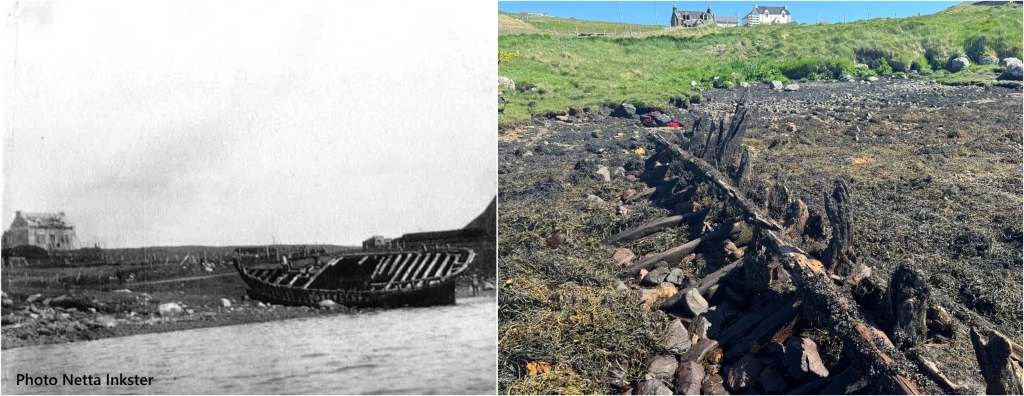
Image on the left shows Candace being broken up for re-use. Ladybank house is under construction in the background. Image on the right shows the same view in 2025. The white house in the background is Ladybank House.
Candace’s story is unique, and she may be the only surviving Lowestoft-built fishing smack in Scotland. Yet her journey reflects that of thousands of herring drifters built across Britain in the final decades of sail. Many fished for 20-30 years, changing hands and ports along the way, eventually ending up in timber-poor regions like Shetland, where they lived on as roofs, lintels, and fence posts. Few survive as visible wrecks—and we’re fortunate to have met this one.
SOURCES:
www.Lowestofthistory.com/fish/vessel2.html
Customs and Excise Register of Fishing Boats CE 85/11
Sail fishermen of Shetland, p152
https://www.bayanne.info/Shetland/getperson.php?personID=I32003&tree=ID1
Recent Comments