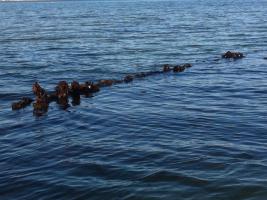
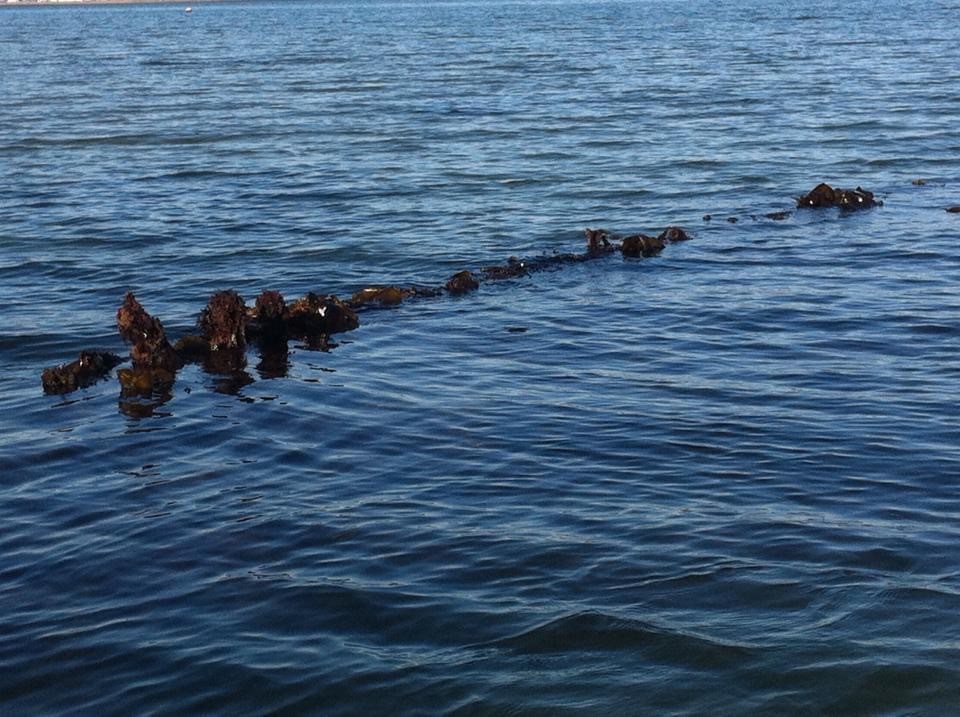
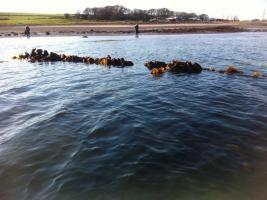
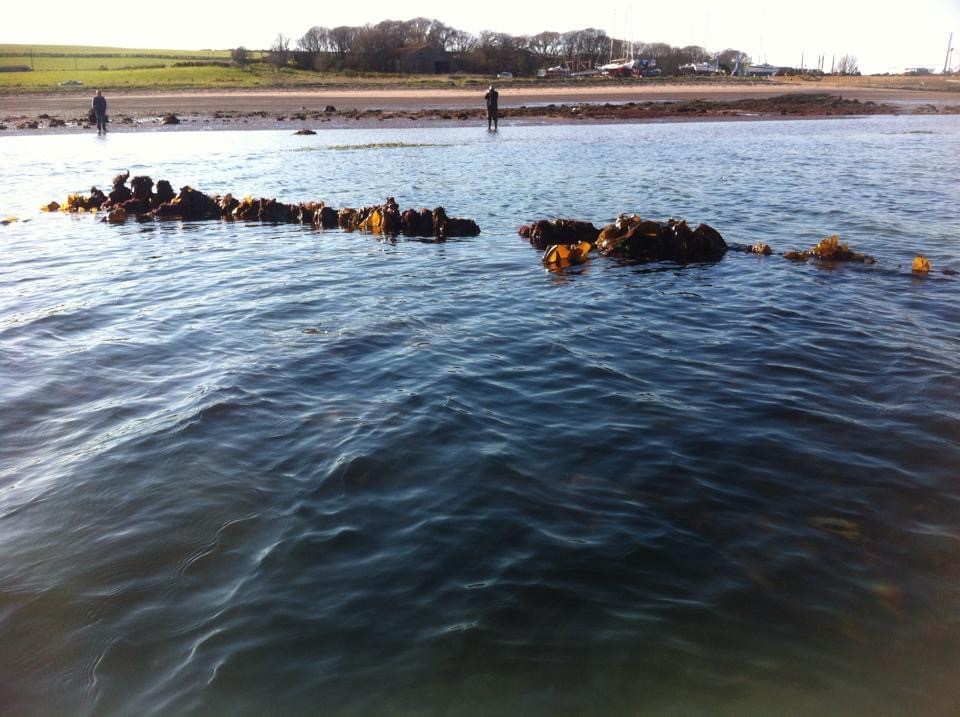
Surveyed in March 2015. Rusted ferrous metal visible though partially submerged at extreme low tides. Overall dimensions 15m by 13.5m. Pembroke Dock Sunderland Trust have been unable to make a positive identification of the remains as those of a flying boat, though the shape visible in aerial imagery suggests this may be either a part of wing or hull, with upright pieces of metal either ribs (if a wing) or formers (if a hull) - though these appear to be too close together for a Sunderland (if these are the remains of a flying boat at all).
The location of the wreck site was pointed out to us, however, it was not visible at the time of survey. The wreck has been extensively researched by a local volunteer, Matt Halliday, who has also waded out to the remains on a very low tide. The wreck is positioned in relatively shallow water and on a extremely low spring tide, the wreck has been seen on satellite imagery to be completely out of the water. The ribs of the wreck are jagged, where they have been cut down to the aircraft's waterline, presumably during scrapping in situ. The keel of the wreck is covered in concretions and seaweed, but there are recognisable rivet patterns, which could match those of a Short Sunderland. The other aircraft type that the wreck could be is that of a SARO Lerwick - a type of aircraft retired from service after only 3 years (21 built, 11 lost, 4 of which were lost at Wig Bay). Matt Halliday suggests that a likely candidate for the wreck is the T9073 (CANMORE ID:299200), as it was the only Sunderland at Wig Bay that caught fire as opposed to "sank at moorings" which means it would have been harder to have refloated the craft to be brought ashore for scrapping.
Location
203617.00
566253.00
27700
54.9521396
-5.0682836
Submitted photographs
Image
Date
Caption
User
17/11/2023
Visible wreckage of possible Sunderland flying boat.
MattHalliday
17/11/2023
Wreckage of possible Sunderland flying boat, looking northwest towards coast edge.